
The (New and Improved) 30-Minute Startup
When I first performed the 30-minute startup demo in Belfast, I thought I was showcasing the peak of entrepreneurial acceleration. I was wrong.
The reality of the AI-Driven Enterprise (AIDE) is that the "peak" is a moving target. AI isn't just changing; it is mutating at a velocity that makes last year’s cutting-edge stack look like legacy software. I have now run this session dozens of times for everyone from undergraduate students to seasoned board members, and the reaction is becoming consistent: it is a session that somehow both scares and inspires them simultaneously.
We haven’t found the perfect word for that specific cocktail of "awe and dread" yet… perhaps awe-ful in its original sense… but the impact is undeniable. It forces a visceral realization that the barrier between "idea" and "execution" has essentially evaporated.
However, the goal isn't just to shock an audience. The goal is to provide a rigorous structure. I’ve refined this workflow to ensure that once the demo is over, teams can take these specific elements back to their own "Tinker Time" and apply them to their real-world problems. Whether you are a solo founder or a corporate executive, the value of this exercise lies in shifting your mindset from "How do we build this?" to "How do we orchestrate the build?"
This transition from being a hands-on manager to a strategic visionary is a core pillar of my upcoming book, No One Works Here (Wiley, August 2026). We are witnessing a fundamental shift in leadership: we are moving from being the "captains" navigating every wave to becoming the architects who define the intent for a fleet of AI agents. In this new era, the leader sets the destination and the logic, while the agents execute the maneuvers to get there.
For Corporates
For the corporate entrepreneurs, board members, and executives who join these sessions, this realization is often the biggest "unlock." They begin to see that while they are responsible for sailing a massive, steady "corporate ship," they also need to build and launch speedboats. These are the nimble, AI-driven ventures that can move faster, pivot easier, and explore new markets alongside the big ship.
To find that venture, corporations generally need to deploy dinghies first, small, hyper-agile probes that can easily navigate tight, narrow spaces and get to shore with limited depth. These dinghies allow you to explore the vast expanse of different market opportunities without risking the main vessel. As these experiments find traction, they get upgraded to RIBs (Rigid Inflatable Boats); these have more stability and structure while maintaining their edge. Ultimately, through continuous iteration, they become the high-performance speedboats that drive the future of the organization. All of these stages, from the first exploratory dinghy to the scaled speedboat, are best enabled and accelerated with AI.
This exercise provides the blueprint for that speedboat, allowing established leaders to recapture the agility of a startup without jeopardizing the stability of the parent organization.
The Steps
Below is the updated April 2026 edition of the 30-Minute Startup stack. The first principles of entrepreneurship remain our anchor, but the sails are now much, much larger.
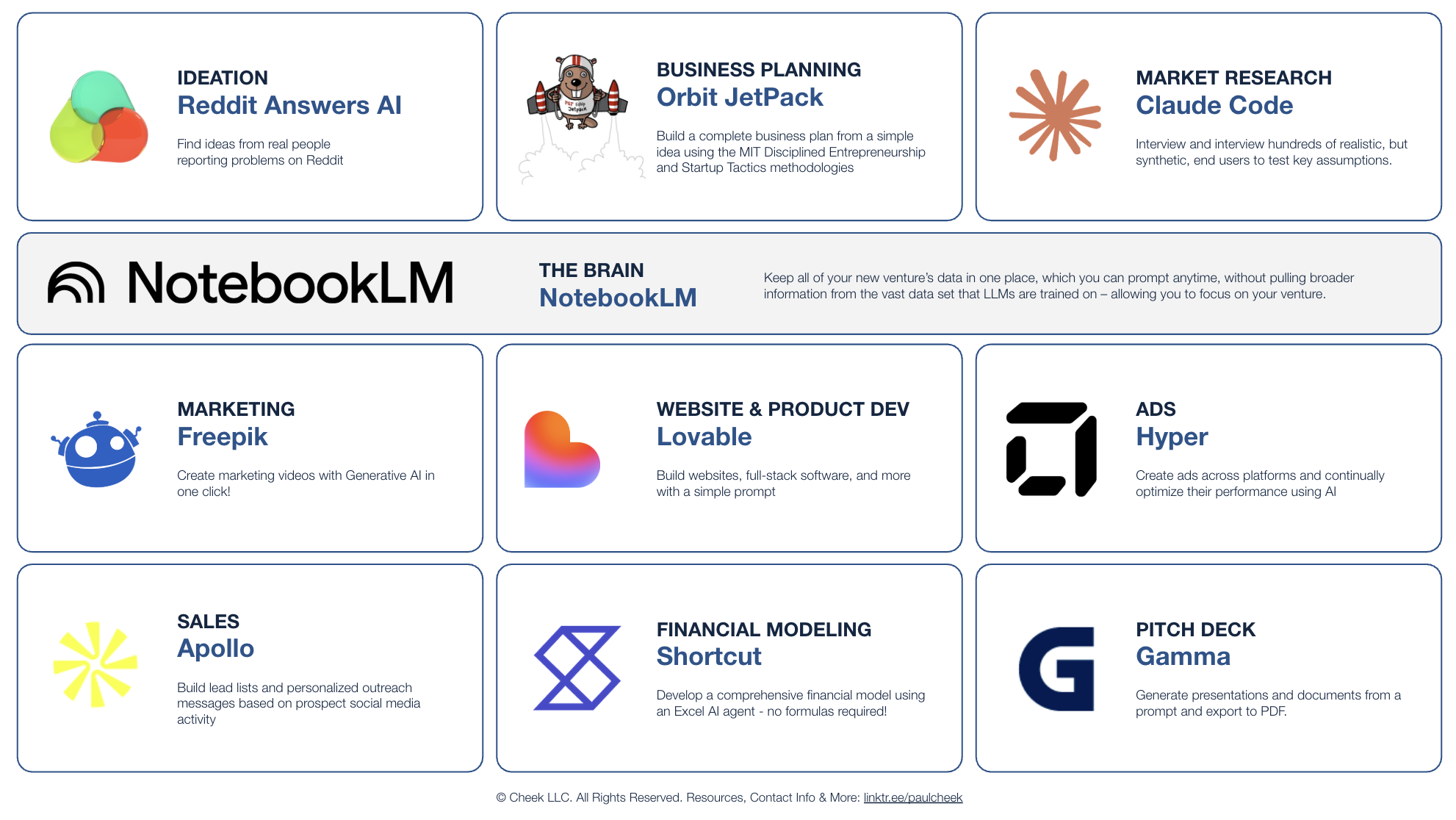
1. Ideation — Reddit Answers AI
The Tool:Reddit Answers AI, a discovery tool designed to find real-world problems within Reddit communities.
How We Used It: We used it to identify recurring pain points and "unmet needs" reported by actual people in specific subreddits.
The Output: A curated list of authentic, validated problems that are currently causing frustration for a specific audience.
First Principles:Problem-First Design. Instead of building a solution looking for a problem, we started with verified customer pain, ensuring there is a "hair-on-fire" market from day one.
2. Business Planning — Orbit JetPack
The Tool:Orbit JetPack, an AI business architect.
How We Used It: We input the core problem identified in Step 1 to build a structured business strategy.
The Output: A comprehensive business plan utilizing the MIT Disciplined Entrepreneurship and Startup Tactics methodologies.
First Principles:Rigorous Frameworks. By using MIT’s 24-step process, we ensured the venture isn't just a "good idea" but a structured business with a defined beachhead market and core competency.
3. Market Research — Claude Code
The Tool:Claude Code, an agentic interface for deep reasoning and simulation.
How We Used It: We used it to conduct "synthetic user interviews," simulating hundreds of diverse end-user personas to stress-test our assumptions.
The Output: Data-driven insights into potential objections, feature preferences, and user needs without the lead time of manual recruiting.
First Principles:Assumption Testing. We treated our business plan as a series of hypotheses and used high-volume simulation to invalidate weak assumptions early.
4. The Brain — NotebookLM
The Tool:NotebookLM, Google’s AI-powered knowledge base.
How We Used It: This served as our Central Command. We uploaded every output from the previous steps to create a closed-loop "source of truth."
The Output: A promptable "Brain" that only references our specific venture data, preventing the AI from "hallucinating" generic advice.
First Principles:Information Synthesis. Entrepreneurship is often about connecting disparate dots; NotebookLM allows us to see the "big picture" across research, planning, and feedback.
5. Marketing — Freepik
The Tool:Freepik’s Generative AI video suite.
How We Used It: We transformed our brand’s value proposition into high-impact marketing videos with a single click.
The Output: Professional-grade video assets ready for social media and landing pages.
First Principles:High-Velocity Content. In the early stages, brand presence is about speed and "vibes." We bypassed the expensive production phase to get visual assets in front of users immediately.
6. Website & Product Dev — Lovable
The Tool:Lovable, a "vibecoding" platform for full-stack development.
How We Used It: We fed the product specifications from Orbit JetPack into Lovable to generate the actual software.
The Output: A functional web application and marketing landing page built through plain-English prompts.
First Principles:Minimum Viable Product (MVP). We moved from "concept" to "functioning code" in minutes, adhering to the principle of building only what is necessary to deliver the core value.
7. Ads — Hyper
The Tool:Hyper, an AI-driven advertising platform.
How We Used It: We used Hyper to generate ad creative and copy across multiple platforms and set up an automated optimization loop.
The Output: A live ad campaign that continuously tweaks its own performance based on real-time click data.
First Principles:Data-Driven Growth. We didn't guess which ads would work; we used AI to run rapid A/B tests to find the lowest Customer Acquisition Cost (CAC).
8. Sales — Apollo
The Tool:Apollo, a sales intelligence and outreach engine.
How We Used It: We leveraged its AI to build lead lists and write personalized outreach emails based on prospects' social media activity.
The Output: A targeted list of "Economic Buyers" and an automated outbound sales sequence.
First Principles:Scalable Outreach. By targeting specific personas identified in our business plan, we ensured our sales efforts were focused on high-probability conversions.
9. Financial Modeling — Shortcut
The Tool:Shortcut, an Excel-integrated AI agent for financial modeling.
How We Used It: We described our revenue model and cost assumptions to the AI agent.
The Output: A professional five-year financial model, including P&L, cash flow, and burn rate projections—no manual formulas required.
First Principles:Unit Economics. We used this to ensure the business is fundamentally sound, checking that the Lifetime Value (LTV) of a customer significantly outweighs the CAC.
10. Pitch Deck — Gamma
The Tool:Gamma, an AI presentation and document generator.
How We Used It: We pulled the finalized strategy and data from our "Brain" (NotebookLM) to generate a narrative-driven deck.
The Output: A polished, investor-ready presentation available as a web link or PDF export.
First Principles:Storytelling & Capital. The final step in any startup is the ability to communicate the vision clearly to stakeholders to secure the resources needed for the next phase of growth.
⚠️ A Warning on "AI Slop"
However, a critical caveat: without continued refinement, this process runs the risk of generating nothing more than "AI slop." If you simply press "generate" and walk away, you have created a ghost ship without a captain or an architect that simply cirlces, not a venture. Nothing replaces the iterative feedback loop fueled by real-world insights. You must take what you learn from real people, bring those insights back into the "Brain" (NotebookLM), and use them to regenerate and revise the content across your entire stack. The AI provides the speed, but human-led iteration based on ground-truth data provides the direction.
Beyond the Demo: Applying the AIDE Model
The power of this exercise isn't in the specific tools, though these are currently the best-in-class,it's in the orchestration. By the time we hit the 30-minute mark, we haven't just "generated content"; we have built a self-reinforcing feedback loop where the "Brain" (NotebookLM) informs the code, the code informs the marketing, and the marketing informs the financial model.
I strongly encourage you to run this exercise yourself. Whether you follow this as a self-guided sprint or use it as a workshop template for your team, the objective is to move past the "wow" factor and into applied experimentation.
Key takeaways for your "Tinker Time":
Don't skip the problem: Tools like Reddit Answers AI ensure you aren't building a "solution in search of a problem."
Build your Brain first: Everything becomes easier when you have a centralized, promptable knowledge base.
Iterate in public: With tools like Lovable and Hyper, the cost of being wrong is now near zero.
If you’re looking to bring this workshop to your organization, or if you need a bit of guidance on how to tailor this stack to your specific industry, please reach out. This is a journey we are all navigating in real-time, and I’m always happy to help others turn that "scary-inspired" energy into actual impact.
What will you build in your next 30 minutes?